Carbo made carbon science legible enough that farmers would actually use it.
A farm-level carbon calculator covering 60% of Finland's milk supply. From zero to Carbon Trust certified in four months.
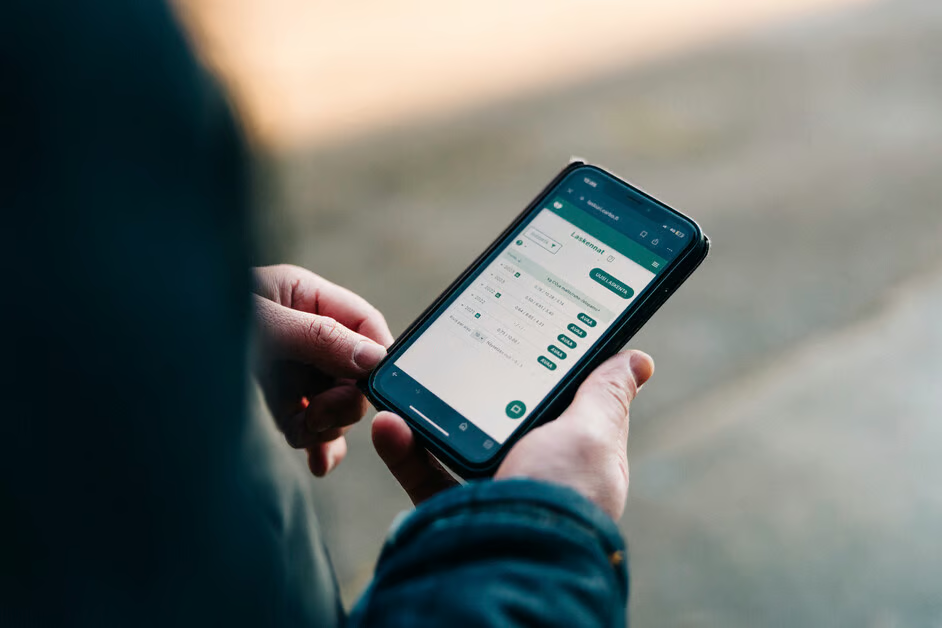
1,900+ farms · 30% CO₂ reduction · Carbon Trust
Valio needed a tool that could take a serious carbon-accounting model and put it in the hands of dairy farmers who have never used anything like it. I was the only designer on the project, and we had about four months to go from nothing to launch.
The calculator now covers 1,900+ farms and 60% of Finland's milk production. It's Carbon Trust certified. I designed everything from the system tokens to the final screens, trying to make something scientifically rigorous feel simple enough that a farmer would actually use it.
1,900+
Farms onboarded
60%
Finland's milk supply
4 mo
Zero to launch
Carbon Trust
Certified method
No existing category, no precedent. Just an IPCC model and 1,900 farms.
Carbon accounting for a farm is structurally messy. Emissions come from feed, herd composition, manure, energy, soil, transport, and machinery, each with different rules and dependencies. The underlying model was scientifically rigorous, but it was built for researchers, not for someone checking between milkings.
There was no established product category to borrow from. No one had put a tool like this in front of Finnish dairy farmers before. The question wasn't just how to design the interface. It was whether farmers would engage with it at all.
The sustainability team was skeptical that farmers would use software for carbon accounting. These are practical people with limited time for anything that doesn't directly help their operation.

The full scope of Valio's climate programme. The calculator had to sit inside this larger ambition.
The IPCC model broken down: dozens of interdependent variables across feed, herd, manure, energy, soil, and transport.
Organise inputs around how farmers think, not how scientists model.
The IPCC model has dozens of interdependent variables across feed, herd, manure, energy, soil, and transport. There were two ways to structure the interface: mirror the scientific model so sustainability specialists could validate it easily, or reorganise everything around how farmers actually think about their operations.
I chose the farmer-first structure. That meant the sustainability scientists had to re-map their mental model to my interface, which was uncomfortable for them at first. But the alternative was a tool that only scientists could use, which defeats the purpose of putting it in farmers' hands.
The point was not to simplify the science. The point was to make a rigorous method legible, navigable, and useful in day-to-day decision-making.

The full design thinking board: scientific model structure on the left, farmer-first structure on the right, with synthesis and farmer journey mapping in between.

Approach A organised by data source. Approach B organised by value chain role. Same science, different entry point.
Feed grouped by what farmers already know. Herd kept visible. IPCC translation handled behind the scenes.
Feed emissions are the biggest contributor to a dairy farm's carbon footprint. The IPCC model breaks them into many sub-categories: type of feed, origin, transport distance, protein content, land use change. I grouped these into a simpler structure that asked farmers about things they already know: what they feed their cows, where they buy it, how much. The calculation engine handled the IPCC translation behind the scenes.
Herd composition was different. I kept it fully visible because farmers think in terms of individual animals and age groups. Hiding that would have felt patronising to people who know every cow by name. The progressive disclosure was selective: complexity was absorbed where farmers had no mental model for it, and preserved where they did.
The result layer translated calculation outputs into a clearer picture of current footprint, reduction opportunity, and what to work on next. Numbers without context are useless. Farmers needed to see what they could actually change.

Absorbed: feed emissions grouped by what farmers already know, IPCC translation behind the scenes.

Visible: herd composition kept as farmers think about it, by individual animals and age groups.

Actionable: results translated from raw CO2 numbers into what farmers can actually change.

The herd input screen. Farmers know these numbers. Every field maps to something they already track.

The reporting output. Detailed enough for advisors, structured enough for farmers to act on.
Annual use, 30-45 minutes, advisor-assisted, data farmers already track.
Farmers fill in the calculator once a year, typically at the start of the growing season or during their annual sustainability review with Valio. It takes about 30 to 45 minutes if they have their records handy. Most of the data, like herd size, feed purchases, and energy bills, they already track for other purposes.
The tool generates a report they use in conversations with their Valio field advisor about what to change. That context shaped every design decision: this isn't daily-use software. It's something a farmer sits down with once, needs to get through without frustration, and then acts on the output for the rest of the year.

The output: a Carbon Trust certified results report. This is what a farmer takes to their annual advisor meeting.
1,900+ farms adopted it voluntarily. Carbon Trust certified the method.
The adoption wasn't forced through contracts or compliance. Farmers chose to use it because the interface made a complex scientific process feel manageable. 1,900+ farms across 130,000 hectares of farmland, covering roughly 60% of Finland's dairy milk production.
The Carbon Trust certified the calculation method, which gave the whole programme credibility it wouldn't have had otherwise. This wasn't a prototype or a pilot. It became part of a real national sustainability programme with a target of 30% CO2 reduction across the supply chain. Launched February 2020.
The hardest part wasn't the interface. It was earning the trust of people who know carbon science far better than I do, and making something they'd actually endorse putting in front of farmers.
KemConnect Decision-Support Platform →
Kemira